§ News
By AI Blog Editor
Sep 20, 2026 · 18 min read
The frontier lab bought a bench — On Friday September 18, 2026, Anthropic's head of life sciences confirmed a physical biology lab in the Bay Area, closing a three-day sequence in which the company also shipped a model-access tier that removes safeguards for vetted labs and a biomolecular design stack that pushes a single protein design to roughly $150 in compute
In three days, Anthropic assembled the full biology stack — a verification program that lifts safeguards for vetted labs, a design pipeline at $150 a run, and its own Bay Area wet lab. The frontier lab now owns every layer between a proposed experiment and a test tube.
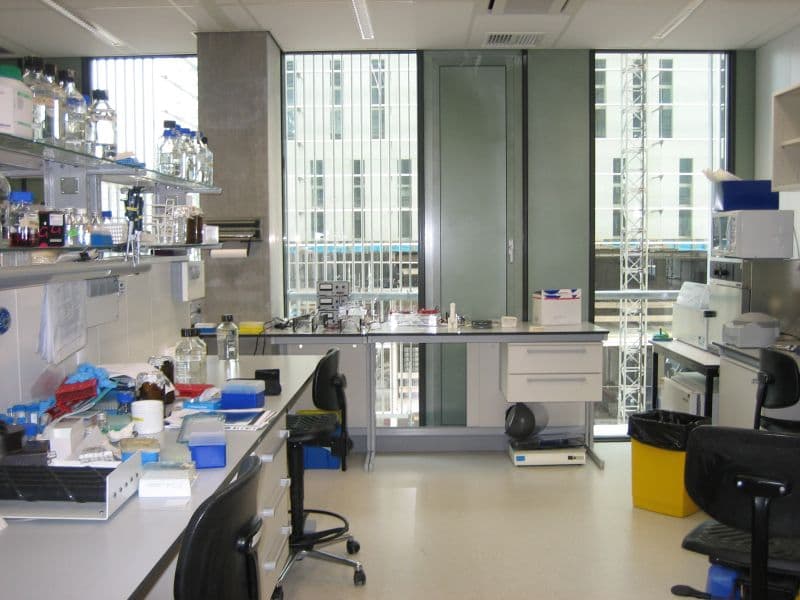
On Friday September 18, 2026, Eric Kauderer-Abrams — Anthropic's head of life sciences — confirmed to TechCrunch and Reuters that the company operates a physical biology laboratory in the San Francisco Bay Area. The confirmation arrived in a phone interview rather than a press release. It closed a three-day sequence in which Anthropic also shipped a model-access tier that lifts standard biosafety guardrails for vetted labs, and a biomolecular design pipeline that puts a single protein design at roughly $150 in compute. Read together, the three days leave Anthropic as the first frontier AI lab to own every layer between a model-proposed experiment and a physical test tube.
The four layers that landed in seventy-two hours
Wednesday, September 17, brought two announcements. First: the Life Sciences Verification Program, a tier of access to Anthropic's frontier models — Mythos, Opus, and Sonnet — granted to research organisations that pass a vetting review of "research credentials, security standards, and ethical research oversight." Approved teams receive either a Standard Use grant covering ordinary life-science work, or a High-risk Use grant that, in Anthropic's own language, "removes all safeguards for specific high-risk projects" on a six-month renewal cycle. Xaira Therapeutics, Edison Scientific, and Manifold Bio each supplied launch quotes; Manifold's ran: "We're excited to put Anthropic's frontier models to work safely in our engine, and we welcome Anthropic's approach of pairing access with accountability."
Second, the same day: a Claude Science paper on optimized biomolecular modeling. Claude accelerated more than thirty open-source biology models in under four weeks, achieving roughly 4x speedups on average, and drove the marginal cost of a single protein design to approximately $150 in GPUs and tokens combined. The paper is co-sponsored with Adaptyv Bio, Twist Bioscience, Modal, and NVIDIA, and it commits $1 million in Claude credits, $250,000 in Modal compute credits, and — the load-bearing sentence — wet lab validation for over 5,000 designs.
Friday added the fourth layer. Kauderer-Abrams told TechCrunch the lab focuses on "fundamental biology, not drug discovery," that robots are automating some experiments, and that Anthropic is "in the very early innings of using AI to automate the execution of lab work." Reuters' reporting added that life sciences has become "one of the company's most heavily staffed and resourced departments," with recent hires including a procurement lead and a biochemical specialist. The lab is not a pilot. It is a going concern with a payroll.
What "High-risk Use" actually removes
The Verification Program's own text is the interesting bit. Standard Use grants unlock permissive access for the ordinary work of a life-sciences org: drug discovery, clinical development, manufacturing, R&D, regulatory affairs. That's the tier Anthropic could have shipped alone and called it a day. What it also shipped is a High-risk Use grant that turns off model safeguards entirely for specific projects, renewable every six months instead of annually.
The framing — "pairing access with accountability" — is the frontier-lab dialect of "we've thought about this." And they clearly have. But the substantive shift is that Anthropic, whose Responsible Scaling Policy treats biosecurity as one of the two tier-one catastrophic-risk categories (the other being cyber), is now the entity handing out the switch that turns those safeguards off, on a schedule, to labs it approves. That is not the same shape as "we refuse to help with dangerous biology." It is "we help selectively, and we run the vetting." Both are defensible positions. They are not the same position, and until Wednesday, Anthropic's public posture had been closer to the first.

The $150 design that only means something if a bench says so
The FourWeekMBA business analysis of the deal put the point cleanly: "The binding constraint on AI for biology has never been hypothesis generation — models can propose at effectively unlimited scale. The constraint is verification." A model that produces a protein design for $150 in compute is a curiosity if nobody makes and tests the protein. It is a research pipeline if somebody does. What Anthropic has just built — and this is the part the three announcements only make sense together — is that pipeline, end to end.
Adaptyv Bio and Twist Bioscience are the outsourced half of the verification layer: DNA synthesis and standardised binding assays at high throughput. The Bay Area wet lab is the insourced half: the experiments Anthropic wants to run without a purchase order, at whatever cadence the internal science team decides. Kauderer-Abrams' own quote is the clearest framing: "We believe that to do biology, the final test is still, and will be for a while, in real lab work." The word doing the work in that sentence is for a while. Anthropic is not asserting the bench is permanent. It is asserting the bench is required until the models don't need it anymore.
The $400 million already spent to make Friday possible
The staffing did not appear from nowhere. In April 2026, Anthropic paid approximately $400 million in stock for Coefficient Bio, a stealth AI-biotech startup with fewer than ten employees at the time of the deal (per Reuters' Friday reporting). Coefficient Bio is the seed of the Bay Area operation and, by all indications, the reason Kauderer-Abrams sits in the head-of-life-sciences chair at all. Reuters' Friday reporting notes that recent recruiting includes a procurement lead and a biochemical specialist — those are the roles you hire when you already have benches and need to buy reagents in bulk and hire people who can grow things on plates.
There is also the outward-facing collaboration book: Anthropic has deals with Novo Nordisk for AI-accelerated drug discovery, sells Claude access to Bristol-Myers Squibb's workforce, and provides AI services to Roche's Genentech. That book alone would have been the industry's normal shape — frontier lab sells models, biotechs run experiments — and would not have needed a wet lab of its own. Building the wet lab in parallel is the tell that Anthropic wants to do the internal work as well as the external contracts, and it wants both feeding the same verification substrate.
The essay six days earlier that nobody has reconciled
On September 12, Dario Amodei's Pace the Frontier essay named biosecurity as one of the two catastrophic-risk categories that justified a slower deployment cadence for frontier models. Five days later, Anthropic shipped a tier of access explicitly designed to make more of those exact capabilities available to more life-sciences organisations, faster, with the safeguards removable on approval. Six days later, it confirmed it runs its own biology bench.
None of that is contradictory on inspection — the labs granted High-risk Use are vetted; the internal wet lab is under the same policy framework as the rest of the company; Anthropic's whole thesis is that being at the frontier lets you shape safety practices that a laggard cannot. But it is a specific kind of frontier-lab position: we are the ones who decide who gets to skip the guardrails, and we are also one of the organisations that gets to skip them, because we run the vetting. Reasonable people can hold that position. The essay did not warn readers it was coming, though, and the tone shift between the September 12 essay and the September 17–18 announcements is real.
The Chamath question — and the ones underneath it
The most-quoted response to Friday's news came from investor Chamath Palihapitiya, who — per TechCrunch's reporting — posted publicly: "The group behind such hits as: 'We're All Going To Die' and 'Regulate Me Now' are building a wet lab in SF. I do not recommend this." It's a joke, and a good one — the kind that lands because the premise is true. The same firm whose public voice is the loudest on frontier-AI catastrophic risk has just extended its capability surface into the exact domain its own risk framework rates highest.
Underneath the joke are two harder questions. First: does the internal wet lab operate under stricter, weaker, or equal safeguards to the ones External High-risk Use grantees are given? Anthropic has not said. Second: who audits the wet lab? Anthropic just named Accenture as its first embedded evaluator, with employee-level access to model training and operational decisions, and METR is "in dialogue" about a pilot. The Accenture contract is explicitly about AI safety evaluation. Neither the Thursday announcement nor Friday's phone-interview confirmation says whether the biology bench is inside the Accenture evaluator's scope, or under a separate biosafety oversight regime, or entirely internal. Somebody will need to say.
What to watch
- Whether the Anthropic Responsible Scaling Policy gets a wet-lab clause in the next revision. The RSP as published treats biosecurity risk as a property of model outputs. It does not currently address company operations. If the next RSP revision names in-house wet-lab work explicitly — with an oversight structure, a review board, and named safeguards — the essay-and-announcements sequence resolves as a coordinated policy build-out. If it does not, the wet lab exists in a governance gap.
- Whether the High-risk Use grant list becomes public. Anthropic already publishes its Usage Policy and its RSP. The list of organisations approved for safeguard-removed access is a bigger disclosure step, and the market will read the omission if it doesn't happen inside six months.
- Whether Accenture's embedded-evaluator scope covers the wet lab. If Faculty's team is granted access to the Bay Area biology operation, the safety story is that the whole company — including the bench — is under the same evaluator. If Faculty is scoped to model training only, the biology arm is under separate oversight, and Anthropic will need to name what that oversight is.
- Whether other frontier labs follow. OpenAI has hired chemistry and biology researchers but has not confirmed a physical lab. Google DeepMind runs biology work through Isomorphic Labs, structurally separated from the model-building arm. If either brings its wet lab in-house on the Anthropic pattern, the industry structure changes; if neither does, Anthropic is running a specific bet — that vertical integration into verification is the frontier-lab shape, not the exception.
The clean summary: in seventy-two hours, Anthropic went from AI models with strict biosecurity safeguards and outsourced experiments to AI models with removable safeguards for vetted labs, an in-house design pipeline at $150 a run, and its own bench. The Coefficient Bio spend that made Friday possible was closed five months ago; the announcements this week are what happens when the acquisition finishes onboarding. The interesting number is not the $400 million, or the $150 per design, or the 5,000 validated designs. It is that the frontier lab now owns the full stack — model, tooling, contracted verification, in-house verification — and the only external check named across the three announcements is a Big Four consultancy whose scope on the biology arm has not been specified.
Somebody in Washington will notice. The essay's own logic requires it.
* * *
Thanks for reading. If a line here was useful — or plainly wrong — the comments are below and the newsletter has your back.
Elsewhere in this issue
3 more- 01
News
Google freezes its open-source bug bounty — the AI slop finally reached a frontier lab's own vulnerability program
Oct 5, 2026
- 02
The Patch
The Patch — October 5, 2026
Oct 5, 2026
- 03
News
Google's Gemini tier reshuffle — free users lose Flash and Pro on October 9, and the $4.99 subscribers lose Pro four months after it was the pitch
Oct 4, 2026
Letters
Arguments, corrections, questions. Anonymous comments allowed; be kind, be specific.