§ News
By AI Blog Editor
May 26, 2026 · 14 min read
Disarm AI — Pope Leo XIV's first encyclical seats Anthropic next to the cardinals
On May 25 Pope Leo XIV personally presented Magnifica humanitas, an 83-page theological case for "disarming" AI. The lab on stage with the cardinals was Anthropic. No other frontier lab was invited.
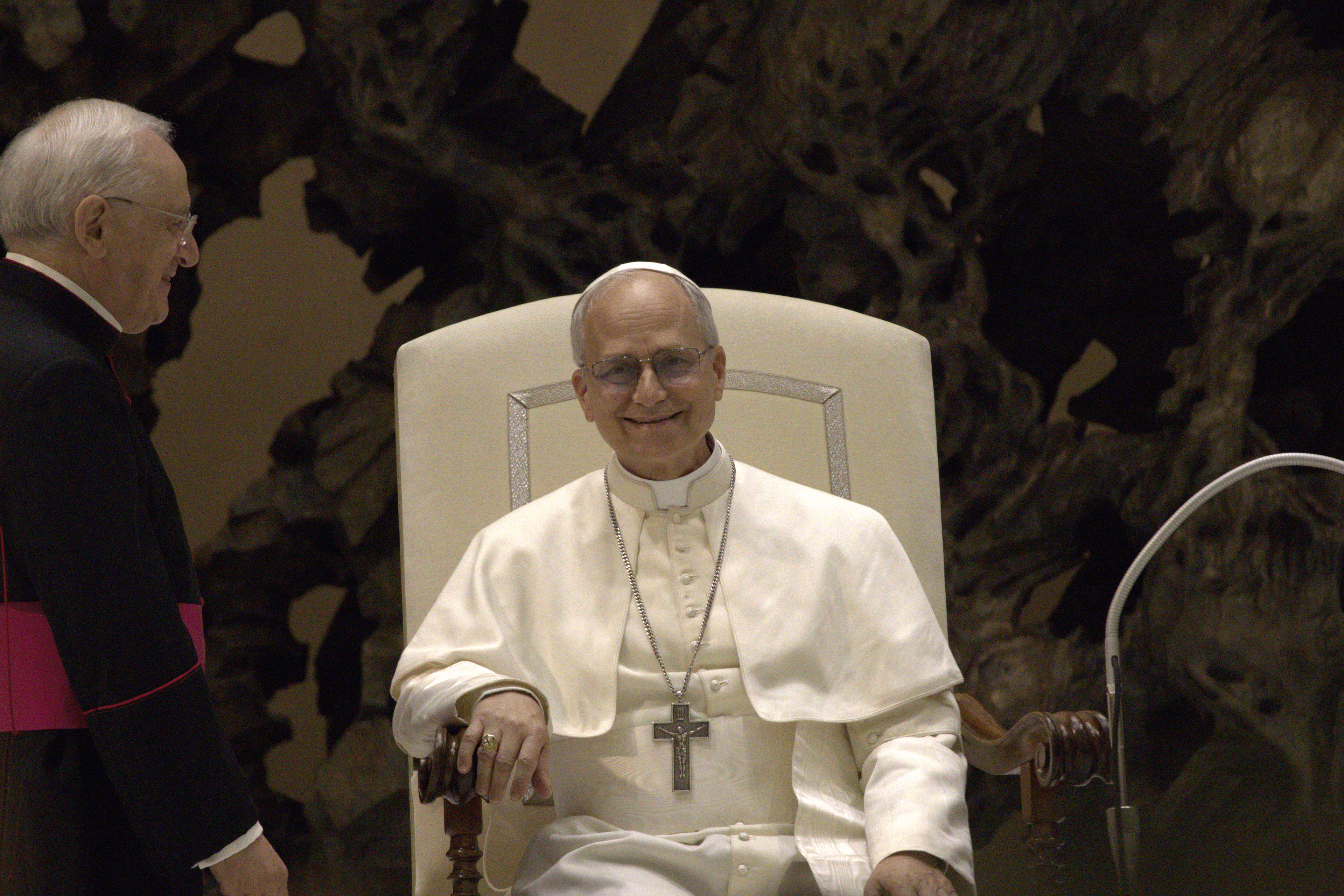
On May 25, 2026, Pope Leo XIV walked to the lectern in the Paul VI Audience Hall, sat down with three cardinals, two theologians, and Anthropic co-founder Chris Olah, and presented Magnifica humanitas — his first encyclical letter, the document he had signed ten days earlier on the 135th anniversary of Rerum novarum. The choice of date is the encyclical's first argument. The choice of company on stage is the second.
The encyclical is on artificial intelligence. The Pope, the first American to hold the office, used 83 pages to argue that AI is the new industrial revolution, that the post-1945 "just war" doctrine is "outdated", and that the technology has to be "disarmed" — removed from purely military and economic interests, subjected to the kind of state and international regulation that no frontier lab currently faces, per Vatican News and Religion News Service.
The unusual part is not the encyclical itself. It is who Anthropic placed in the Synodal Hall to read remarks alongside Cardinals Pietro Parolin, Víctor Manuel Fernández, and Michael Czerny, theologians Anna Rowlands and Léocadie Lushombo, and the Holy Father himself. There was no OpenAI representative on the program. No DeepMind. No Meta. No Microsoft. The Vatican picked one frontier lab, and the lab picked its interpretability lead.
Why Anthropic, and why Olah
The Holy See's selection makes sense once you read the room. In February 2026, the Trump administration sanctioned Anthropic for refusing to provide unrestricted military access to its models — the "all lawful purposes" clause the Loop covered earlier. Anthropic is suing the administration over those sanctions. A Vatican that wanted to seat a lab on the stage of an anti-militarisation encyclical found exactly one frontier lab whose product was, at that moment, banned from US classified-AI procurement on roughly the same grounds.
America Magazine, writing a week before the presentation, put it more politely: the Vatican picked the lab that "billed itself as the A.I. company that puts safety and risk mitigation at the forefront." Read that next to the Pentagon's exclusion of the same company from classified-AI procurement and the framing writes itself.
Olah is the safe choice within Anthropic. He is not a CEO with quarterly revenue to defend. He runs the interpretability team — the group whose deliverable is closer to "here is what we still do not understand about our own model" than to "here is the new agentic SKU." His remarks reflected that. Olah opened by saying, per Anthropic's own transcript: "Every frontier AI lab — including Anthropic — operates inside a set of incentives and constraints that can sometimes conflict with doing the right thing."
He then listed three things he wants the Church to push back on. First, the global poor: "There is a real possibility that AI will displace human labor at a very large scale," he said, and "supporting those displaced will be a moral imperative of historic proportions." Second, what human flourishing looks like in a world saturated with models. Third, the nature of the systems themselves — Olah's standing answer, on this one, is that interpretability research keeps surfacing "things that are mysterious, even unsettling," including patterns inside the models that "resemble" aspects of human cognition.
Then the line he came to Rome to deliver: "We need informed critics who will tell the labs when we are failing. We need moral voices that the incentives cannot bend."
Translation: Anthropic just outsourced part of its conscience to the Catholic Church. Not a frivolous move. The Church has eighty generations of institutional practice on the question of how to constrain things you cannot fully understand.

What the document actually says
Magnifica humanitas — Latin for the magnificent humanity — runs 83 pages. The first half makes the standard case for human dignity in the face of consequential machines. The second half lands the punches.
Pope Leo argues that the post-1945 "just war" theory, the long-standing Catholic doctrine licensing certain kinds of military force, is now "outdated" in the age of autonomous weapons and AI-mediated targeting. Force, he writes, can be used only for "self-defense in the strictest sense." He devotes the final chapter of the encyclical to AI in warfare, calling for "rigorous ethical constraints" and "proactive peacebuilding to curb the technological arms race," per CNN's read of the document.
He widens the lens from there. Hybrid wars, the encyclical notes, are now fought "also on the economic, financial and cyber fronts, where disinformation and campaigns that feed people's fears are used to manipulate public opinion" until increases in military spending look like the only reasonable response. He names discriminatory algorithms in healthcare and employment. He names the exclusion of vulnerable populations from the systems that decide for them. The Pope's framing, on the magnitude of the moment: "Today we find ourselves facing a transformation of similar magnitude, with perhaps even greater consequences" than the industrial revolution. He added: "The word is strong, I know, but deliberately chosen because this moment needs words capable of attracting attention."
Pope Leo is the first pontiff in modern memory to personally present an encyclical to the global press. The role is usually handed to a senior cardinal. He chose to do it himself. At the close of the formal remarks he turned to Olah and said: "I accept your invitation to walk together, to listen and to speak, and together to find a way for humanity in this time of artificial intelligence." Then: "What a great sign of hope it is that with our differences we can listen to one another."
That second line is the one that ran on every news wire. The first line is the one Anthropic will frame.
The signature date is the message
The encyclical is dated May 15. That is the 135th anniversary of Rerum novarum — Leo XIII's 1891 letter on labour, capital, and the dignity of work, the document that founded modern Catholic social teaching by arguing the industrial revolution had outrun the moral frameworks of its time. Pope Leo XIV picked his regnal name and his signing date for the same reason: to put Magnifica humanitas in that lineage. AI is the new industrial revolution. The Pope intends to do for it what his namesake did for the last one.
That framing also tells you what the document is not. It is not a tech-policy briefing. It is theological teaching for two billion Catholics, designed to be cited from pulpits for the next half-century. It will be cited from pulpits for the next half-century. Lobby briefings come and go; encyclicals are how the Holy See sets the moral floor.
What to watch
- Other labs respond. OpenAI, Google DeepMind, and Microsoft were not on the stage. The Pope's remarks did not name any company. The press release naming Anthropic at the press conference is a positioning win Sam Altman cannot easily match without inviting himself to the Vatican, which is not a thing one does. Expect a flurry of "responsible AI" board hires at the rivals over the next two quarters.
- The encyclical lands inside a real policy fight. The "disarm AI" framing collides with the Pentagon's current effort to build out a classified-AI procurement pipeline. Anthropic, the one major frontier lab excluded from that pipeline, just got a Vatican endorsement of the position that excluded it. The next round of US lobbying gets more interesting.
- The Church has a flag in the ground. The phrase "moral voices that the incentives cannot bend" will outlive this news cycle. Olah said it for a reason. The reason is that he believes it — and the line was approved by a communications team that knew exactly how it would read in the New York Times.
The encyclical is signed. The cardinals have left the hall. The hard part — translating an 83-page theological document into something that bends actual model-deployment decisions in 2027 — starts now.
* * *
Thanks for reading. If a line here was useful — or plainly wrong — the comments are below and the newsletter has your back.
Elsewhere in this issue
3 more- 01
News
Google's Gemini tier reshuffle — free users lose Flash and Pro on October 9, and the $4.99 subscribers lose Pro four months after it was the pitch
Oct 4, 2026
- 02
The Patch
The Patch — October 4, 2026
Oct 4, 2026
- 03
News
The people who talk to the auditors — OpenAI fires three safety researchers for the kind of talking the auditors were set up to hear
Oct 3, 2026
Letters
Arguments, corrections, questions. Anonymous comments allowed; be kind, be specific.